
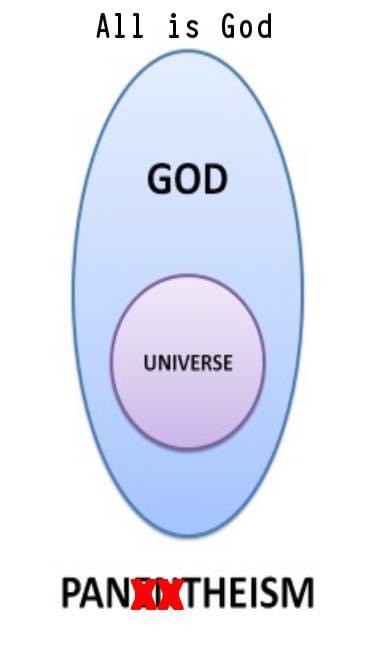
This is intended neither as an argument for nor against God as commonly understood — just simply a use of non-dual logic and the common accepted definition of pantheism that prefaced Part One:
“Pantheism essentially involves two assertions: that everything that exists constitutes a unity and that this all-inclusive unity is divine.” – Alasdair MacIntyre, Encyclopedia of Philosophy, “Pantheism” 1971
So, substitute the words “the Divine” or “the Great Mystery” or “Unmanifest Potential” or “Source” or “Nature” (if Nature is antecedent to this particular form of the Universe or “verse”) for God if you prefer. The main point is that the whole of the diagram on the right, including the inner circle, is the [whatever you call it], one unitary substance, just as the avocado is the whole fruit. And that makes it pantheism.
Confused? Let’s do this as a thought experiment, shall we? If you have an avocado at home, please slice it in half lengthwise so that you’re looking at a cross-section. Or you’re welcome to use this visual aid if not (they’re not cheap).
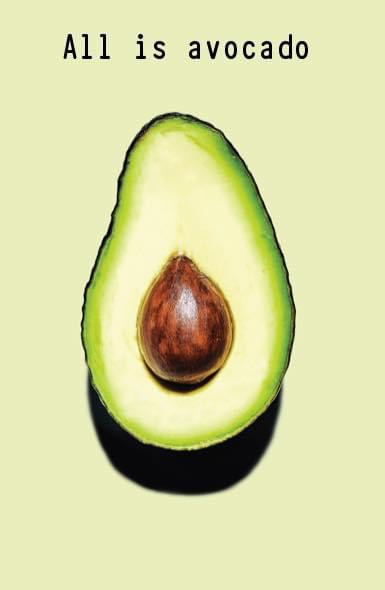
Looking at your avocado, you’ll notice the light green fleshy part, surrounding a light or dark brown pit.
Now, which of these parts is the avocado? Does avocado end where the pit begins? Did someone have to stuff the pit inside the flesh to make a complete avocado? I hope it goes without saying that it is *all* avocado, and that the fruit doesn’t really consist of “flesh plus pit” — it is all of a piece, grown from and as an organic whole.
The relationship between avocado and flesh, or avocado and pit, is an example of non-duality. (What’s less immediately clear but just as true is the non-dual relationship between flesh and pit, because of their shared “avocadoness.”) It doesn’t mean the flesh doesn’t exist or the pit is an illusion — it simply means they don’t exist independent of their “interbeing” with and within avocado.
Now, look for other non-dual relationships of greater scale that your avocado model can represent. Let’s say the pit is the whole fruit itself, and the avocado is your kitchen. Or, the pit is your kitchen and the avocado is your house…your house and the country where you live…your country and the earth….
Follow the logic all the way out to its limit, and you can see the pit as the entire known, physical universe, and the avocado is….not important to this experiment yet. Don’t get your mind in a twist over it. Just accept that, like the pit within the avocado, the measurable universe is grounded in something immeasurable, even if you see that something as “nothing.”
This brings us back to the PanXXtheism diagram.
A fundamentalist theist will tell you that God and the universe are separate things, therefore God might surround the universe like the flesh does the pit, but there is no interbeing involved…and yet they’ll also claim that God is omnipresent. Baffling, but that’s what dualism does to the human thought process 🤪
I’ve heard it said many times that all monotheists would agree with this dualistic model, but that is far from true. There are plenty of theologies which wrestle with the logic of “qualified non-duality” and the intermingling of the divine and material realms, which is why panentheism is a real thing. The Eastern Orthodox churches, especially the Greek, are openly panentheistic because there is a more established cultural history of non-dual thought. Chinese Christians are more or less Taoists with a personal concept of Tao. It is hardly cut and dry outside the narrow confines of the West…and it was into those narrow confines that Spinozan pantheism was born, so that it could radically change the concept of our relationship with the ultimate ground of being.
God, according to Spinoza, is the whole avocado. Not just the flesh, not a timeless being reaching its divine tendrils into time. The whole thing. Just like an avocado consists of the part you eat and the parts you don’t, God — or the divine substance of Existence itself — consists of parts with measurable physical dimensions, and that which doesn’t; these are analogous to matter and mind, only unlike in Cartesian dualism, matter and mind are coarising. There is not one without the other. (Picture the flesh and pit swirling together like a yin-yang.)
Is it possible to simply say “God=Universe” like the pantheism diagram that usually accompanies this one? Sure, that’s more or less what the Tao is when expressed as the yin-yang. But then it would be mighty hard to claim the Universe is its own ground of being AND is only 13.7 billion years old, beginning as a Big Bang-like event and expanding from an infinitesimal point (into what?) etc. Perhaps what we are fishing for is a model for cycles of time, creation and destruction and recreation without beginning or end. That discussion takes a complicated turn toward multiverse theories and simultaneity that’s beyond our scope, but an inconvenient fact remains: any dynamic process involving measurable properties is happening within an immeasurable ground. You can pan back indefinitely looking for greater context as the avocado thought experiment demonstrates, but you’re just moving the goalposts indefinitely. Finity always infers infinity.
We must therefore at some point acknowledge a timeless ground to all these models. The possibilities are vast and no one has the last word on them, but that there is more to the simple “this equals that” diagram is undeniable.
So, that’s why we have to get past this simplistic idea that anyone who postulates that the all-encompassing unity of pantheism extends beyond the physical universe is a panentheist. Non-dual logic, the intelligence of Nature itself as opposed to human-made semantic logic, suggests otherwise. Recognizing that it is all one substance makes it pantheism, period. It is simply that holistic thought leads some to see it from the perspective of the whole, which was here before any of us came along to dissect it with our busy thoughts, and we call that whole any of a number of things. In the case of Spinoza, “God.”
Last instructions: remove the pit from the flesh, put the flesh in a bowl and mash it up with a fork, add some chopped red onions and cilantro, minced garlic, and a dash of lime juice. Then mix it all up, spread it on your toast if you’re a Millennial or Gen Z, and enjoy 😋
– from “When I Woke Up: Excerpts from the Notes of Estelle Perdue After the Vince Lombardi Service Area,” featuring ideas derived from the novel UNLESS
 Noesta Aqui