
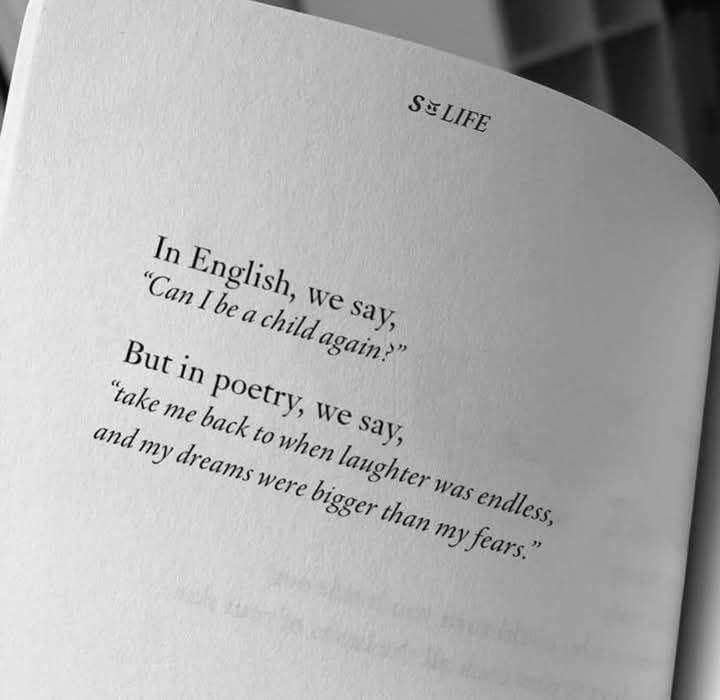
In English, we say, “Can I be a child again?”
But in poetry, we say, “take me back to when laughter was endless, and my dreams were bigger than my fears.”
–widely quoted on social media, source unknown
This is perhaps the simplest, tenderest, most primal wish that we as humans allow ourselves to make as we age. A famous spiritual adept even said, “unless you turn and become like little children, you will never enter the kingdom of heaven.” I suspect this appeared in my media feed today because there is a lot of wishing for renewal and innocence about. So is it possible?
From what I have gleaned over a lifetime of contemplation of the matter from many angles, Yes. Not only possible, but it is the natural outcome, the karmic consequence of your wishing for it now.
You just don’t get to go back to your childhood, the one you identify with now.
But you can be confident that the “I” who thinks your thoughts and looks through your eyes and feels the world as the delicate nexus of your nervous system right now — that “I” will be like a little child again, scrubbed of all cognitive notion of being “you,” but with an intuition that will be giving you hints along the way.
You became who you are now out of your desire to be reborn once before, and you can do it again.
There are, of course, the pains of death and rebirth to endure first, and that’s why some would prefer to “die before they die” and transition seamlessly into the Unity like a drop of water into the Ocean. That’s an option too, and there is no shortage of teachers who will impart to you the wisdom needed for the path of self-annihilation while living. I’m just not a big fan. My desire is to laugh and dream again. It is my intention to return and learn more from the puzzlework of intuition.
You might notice that the whole concept of being a “born again Christian” is an amusing parody of the movement of return. It’s the type of idea that happens when intuitive wisdom seeps in but the structural underlay, the metaphysical framework of one’s thoughts, is too hemmed in by linearity to make truth of it. It is hemmed in by the worldly belief structure that says, for instance, the “I” that is Waldo could only ever be Waldo, so when Waldo dies the “I” must too, or if “I” persists and returns it must mean Waldo returns, or if “I” enters some other post-mortem dimension like Heaven or Hell, then it is Waldo is going there. This is conflating the character and the Actor. Waldo is just the current character, “I” am the Actor. I will play a different role when I return.
Should we rush then into death, like hitting a cosmic reset button? No, because if you consider the karmic implications, it will probably lead to a crummy rebirth. That sounds cheeky, but it’s just the true extension of the principle behind the return. But even more immediately: as long as there is a will in you to breathe and keep moving forward on some pursuit in this life, DO IT. Know that the desire for rebirth will be fulfilled in its right time, and don’t let it become a shadow over the time you have now. Trust me on that one 
But that’s really the summation of what I wanted to say regarding this passage: Your desire for rebirth is good, and your return is assured by it. Take care of what you came here for first.
—from “When I Woke Up: Excerpts from the Notes of Estelle Perdue After the Vince Lombardi Service Area,” featuring ideas derived from the novel UNLESS
 Noesta Aqui