
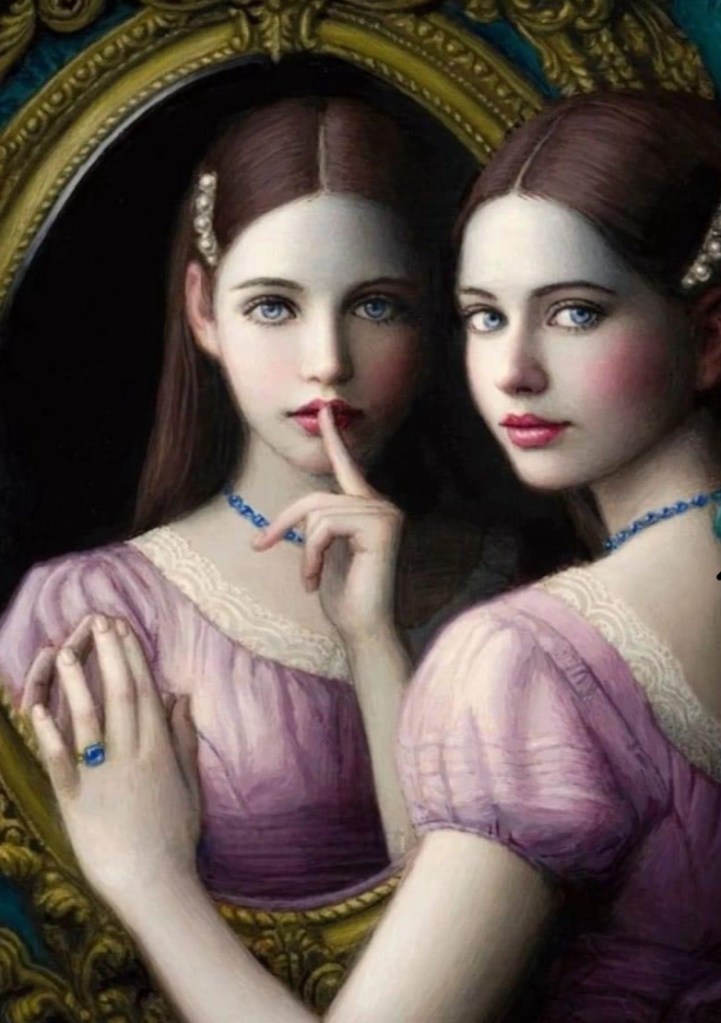
“At a more palatable hour, and aside from the brute fact of having been awake for an extraordinary period of time, Estelle was, according to the standards by which the American teenager is judged, a very pretty girl. (Girl? Young woman? Or perhaps neither; something in between that hasn’t a name?) Exceptionally pretty in fact, with a body that had reached feminine maturity long before it was authorized. Her form and figure had been either envied or coveted by many of her former classmates, and she received rave if often crude reviews in the locker rooms of both sexes. Among her more mature critics, she was revered for her refreshing lack of extravagance, and the way she wore her cover-girl features, sans ornamentation, with the glow of a Christmas tree before it is even cut, let alone trimmed.
(Almost none of these people, it needs to be added, seemed to remember a different era only a few years prior, and the unrelenting, merciless bullying they heaped on the nerdy, gawky, and allegedly fat adolescent duckling who later became their swan. She remembered though. All of it.)
All of these reviews, however, whether verbal or symbolic, or a passing, admiring glance, came to her second- or third-hand, if at all. She was not above self-critique, nor oblivious to the teenage games of attraction and mating ritual rehearsals. But she was almost completely ambivalent about them, and more than a little overwhelmed. When surrounded by the glare of public attention in the fishbowl of teenage life, she often retreated from self-consciousness to the point of ghosting herself. There was of course the social obligation to go through the motions of noticing who noticed her, but caring about what she noticed was an opportunity rarely seized. For instance, while she would indulge any and-then-she-said-and-then-he-was-like conversation in her vicinity, she rarely tried to make sense of the words, and while she had logged her share of grooming and gazing and tweaking time in front of a mirror, her gaze almost never left the vicinity of her eyes, or more particularly, something behind them. In fact, if asked (as she once was, by a puzzled and clearly overmatched psychiatrist, before receiving a Prozac prescription), she could hardly remember a time when, looking at herself in a mirror, she saw anything at all — and when she did, it was someone who wasn’t there.” -– UNLESS (2024)
Mental health, especially through the harrowing purgatorial years between adolescence and bona fide young adulthood, is a major theme of UNLESS. The protagonist, 18-year-old Estelle Perdue, exhibits a wide range of disorders that are common at her age: clinical depression, dissociative disorders (especially depersonalization and derealization), and — though I never used the descriptor because I was today years old when I found out it is an actual clinical diagnosis — maladaptive daydreaming. Possibly a lot more of the latter than is immediately apparent.
I have experience with all of these, with the important exception of depression. Daydreaming myself into different people and different scenarios for those lives, sometimes to the point of getting lost in them on the way back to myself, was a coping skill that goes back as far into childhood as I can remember. It persisted well into adulthood, in fact, up until the point that I learned what I needed to know to write this book. I was never diagnosed because for the most part, it was a closely guarded secret, but also because it helped keep the manifestations of depression under control. Assuming the identity of Waldo Noesta in 2016-17 as I was recovering from what felt like multiple layers of life failure was a major part of this.
According to the Mayo Clinic, “Depersonalization-derealization disorder (DDD) occurs when you always or often feel that you’re seeing yourself from outside your body or you sense that things around you are not real — or both. Feelings of depersonalization and derealization can be very disturbing. You may feel like you’re living in a dream.” (Interesting that we tell kids to merrily row their boats gently down the stream because “life is but a dream,” then slap them with a disorder label when they take it seriously.)
The funny thing about DDD is that even the shrinks acknowledge that these are things that most people sometimes do without harm. What makes it a disorder, it seems, is passing a certain threshold of discomfort and/or inability to control the behaviors. If DDD doesn’t cause us more stress than it relieves, in other words, then it’s not a “disorder,” just a quirky part of being a person, perhaps one with a more elastic sense of self. What might be a burden in some lives or lines of work, though, could be very good for acting or LARPing, or maybe even writing books 🤓📚
But what if all of these behaviors, including and maybe especially the uncomfortable ones, are an essential part of self-actualization, spiritually or otherwise?
Those who have read any of my previous work surely know where I’m going with exploring dissociative tendencies as part of a spiritual path. Mystics from all traditions have done so for millennia. But that isn’t the direct focus of UNLESS. This is a book about the potential for the worldly arts – particularly the “twin powers” of music and writing – to cause the same transformation of the self, and the role of “maladaptive” psychological traits in the creative process.
There is plenty of overlap of course. One major influence of mine comes from this alleged saying of Jesus in the Gospel of Thomas: “If you bring forth what is within you, what you bring forth will save you. If you do not bring forth what is within you, what you do not bring forth will destroy you.” Though the quote doesn’t appear in the book, I use the phrase “bring forth” a few times to establish the connection. Another quote, which does appear in full more than once for emphasis, comes from the punk vocalist icon Henry Rollins, in a Rolling Stone interview I fortuitously read back in 1994 and retained in my memory banks: “Music is made by those whom music saves.” As a key character affirms at a pivotal point, “It works with writing too.”
Jesus Christ and Henry Rollins. An interesting pair of role models, no? But it’s always worked for me.
So how does Estelle use her maladaptive traits to bring forth what is within her, and find salvation from her disorders through her natural ability to write? Too long for an email. You’ll have to read the book 🙂
Fortunately, you don’t have to wait for the paperback release to find out! The Deluxe DIY Edition of UNLESS is available NOW. And you’ll get even more levels of insight thanks to the bonus material included in “The Untold Story of ‘Angry Youth: The Untold Story’” which only comes with the Deluxe e-book.
Originally published in the Noesta Aqui newsletter edition #23, 2 June 2024. Sign up for the mailing list here.
 Noesta Aqui